
# CLINICAL CASE STUDY: Non-Surgical Hair Restoration via Stem Cell Activation & NBUVB
## Executive Summary
* *Patient Name:* Mr. Ashraf P.V.
* *Age:* 52 Years
* *Diagnosis:* Advanced Androgenetic Alopecia (Grade V/VI)
* *Treatment Modality:* Target Stem Cell Activation Therapy + Narrowband Ultraviolet B (NB-UVB) Light Therapy
* *Treatment Duration:* 3 Sessions (Non-Transplant Protocol)
* *Objective:* To evaluate the efficacy of combining follicular stem cell stimulation with targeted phototherapy to reverse extensive hair miniaturization and restore scalp coverage without surgical intervention.
## Patient Presentation & Baseline Assessment
Mr. Ashraf P.V., a 52-year-old male, presented with extensive, long-standing hair loss predominantly affecting the frontal, mid-scalp, and vertex regions.
### Clinical Findings (Pre-Treatment)
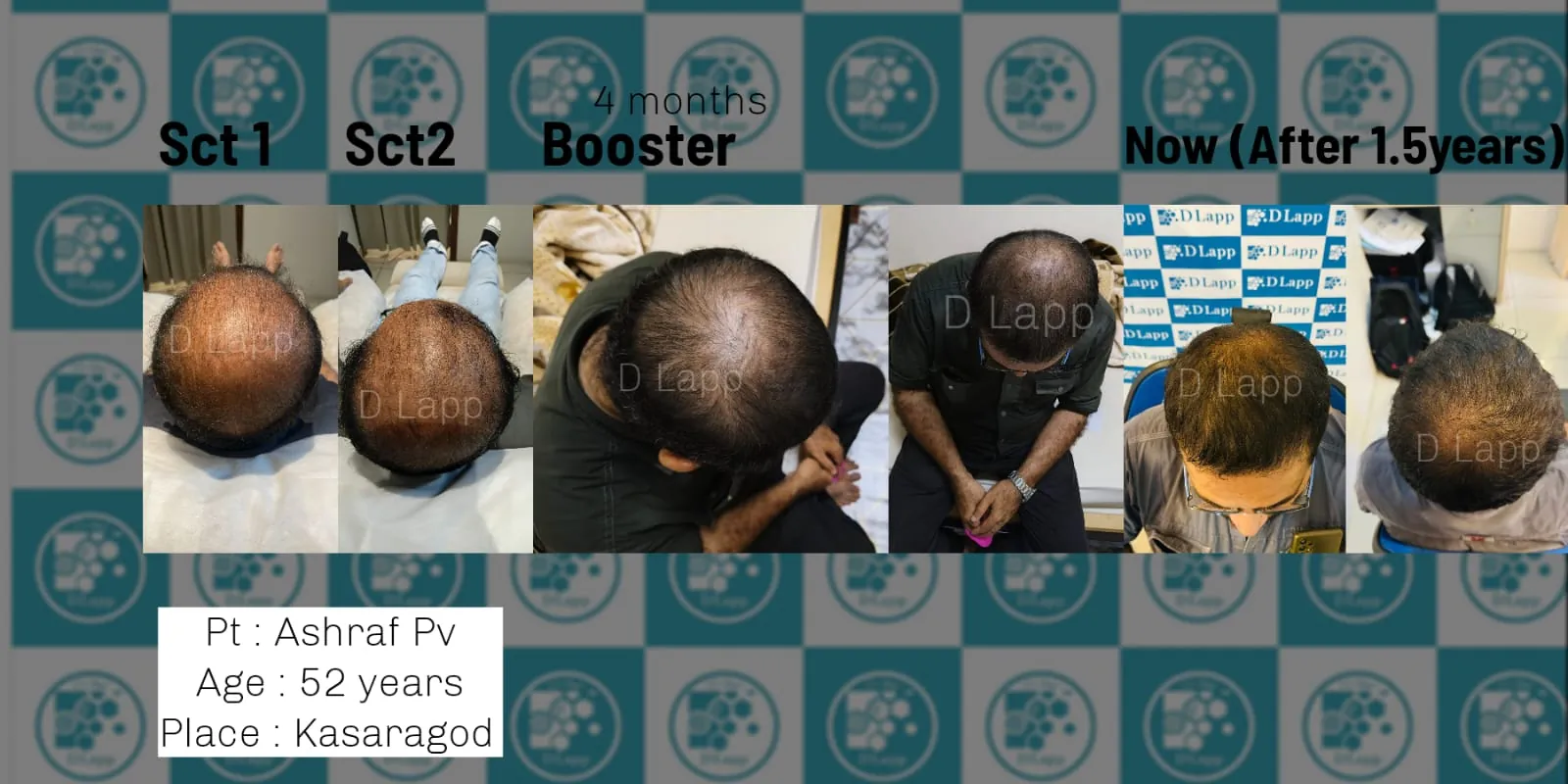
* *Image References:* 1000999559.jpg (Labeled: Ashraf.p.v.56/m sct first sitting) and 1000999565.jpg.
* *Scalp Analysis:* Severe follicular miniaturization across the entire superior aspect of the scalp. The vertex and mid-scalp exhibited profound thinning with a high percentage of dormant/quiescent hair follicles, leaving a very sparse bridge of hair between the frontal hairline and the crown.
* *Classification:* Advanced Male Pattern Baldness (Androgenetic Alopecia).
* *Surgical Viability:* Due to the extensive area of thinning, a traditional hair transplant would require an immense number of grafts, potentially exhausting the occipital donor zone or yielding sub-optimal density. The patient elected for a non-surgical regenerative approach.
Baseline State: Profound thinning -> Quiescent follicles -> Minimal scalp coverage
## Treatment Protocol
The therapeutic strategy focused on awakening dormant hair follicles and correcting the underlying microenvironment using a dual-action, non-invasive methodology.
### 1. Stem Cell Activation Therapy
Instead of physically moving hairs via transplantation, this protocol utilized biochemical signaling to target the bulge region of existing, miniaturized hair follicles.
* *Mechanism:* Activating dormant follicular stem cells triggers the transition from the inactive telogen (resting) phase into the active anagen (growth) phase, progressively thickening fine, vellus-like hairs into robust terminal hairs.
### 2. Narrowband UVB (NB-UVB) Phototherapy
* *Mechanism:* Delivered concurrently to modulate the local scalp immune microenvironment, reduce micro-inflammation around the hair bulbs, and improve localized microcirculation, ensuring the newly activated follicles receive adequate oxygenation and nutrient delivery.
### 3. Schedule
* The entire transformation was achieved over a tight schedule consisting of just *3 structured sessions*, eliminating the down-time and recovery associated with surgical follicular unit extraction (FUE).
## Progression & Clinical Observations
### Intermediate Stage (Session 2)
* *Image Reference:* 1000999557.jpg
* *Observations:* Early-stage stabilization of hair fall. Microscopic examination and top-down visual assessment revealed a noticeable darkening of the scalp area as fine, miniaturized hairs began to increase in diameter and density across the mid-scalp.
### Final Outcome (Post-Session 3)
* *Image References:* 1000999564.jpg and 1000999563.jpg
* *Observations:* Robust, comprehensive vertex and mid-scalp coverage. The crown area, which previously exhibited bare skin, shows a significant closure of the bald patch. The newly emerged hair blends seamlessly with the existing donor hair in texture, direction, and density.
## Comparative Progress Matrix
| Feature | Baseline (First Sitting) | Post-Treatment (3 Sessions) |
|---|---|---|
| *Vertex/Crown Coverage* | Glabrous skin appearance, highly visible scalp | Dense coverage, closed bald patch |
| *Hair Diameter* | Microscopic, vellus-like thinning | Thick, pigmented terminal hair shafts |
| *Scalp Inflammation* | Unregulated follicular microenvironment | Controlled, healthy microcirculation |
| *Patient Downtime* | None (Non-surgical) | Zero recovery time required |
## Conclusion & Discussion
This case highlights the immense potential of regenerative trichology as a primary alternative to hair transplantation. For patients like Mr. Ashraf, who present with advanced hair thinning but retain viable, dormant follicular matrices, surgical grafting may not always be necessary.
By utilizing *Stem Cell Activation* to awaken dormant roots alongside *NB-UVB* to optimize the scalp environment, significant cosmetic restoration and volume were achieved in just *three sessions*. This dual protocol offers a highly effective, painless, and completely non-invasive avenue for significant hair restoration in male pattern baldness.
Ready to take the first step toward healthy hair? Get in touch with D Lapp Hair Regenerative Clinic today.
