
Early Intervention & Advanced Scalp Regeneration
Clinic: Dr. Nieraj’s D Lapp Hair Clinic (Calicut)
Patient Name: Mr. Sreejith
Age: 35 Years
Location: Calicut
Diagnosis: Grade 6-7 Androgenetic Alopecia (Advanced Follicular Miniaturization)
1. Patient Profile & Assessment
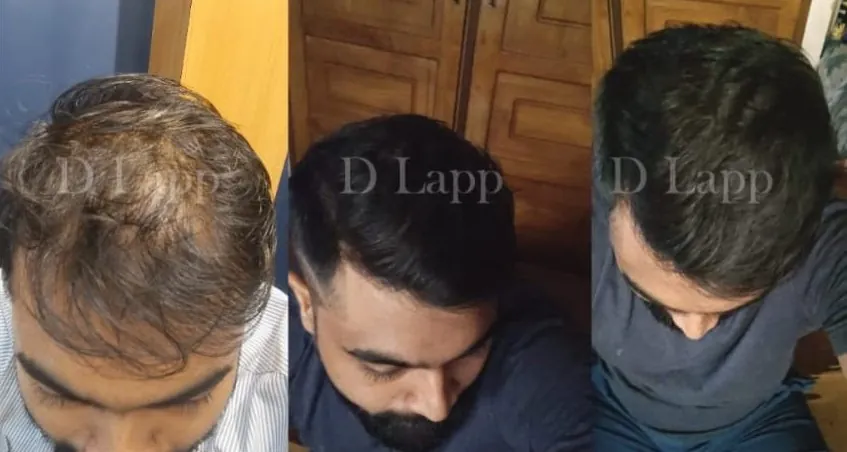
At 35, Mr. Sreejith presented with advanced-stage hair loss primarily affecting the vertex (crown) and mid-scalp regions. Despite his younger age, the progression had reached a point where the scalp was highly visible with minimal terminal hair density remaining. The objective was to utilize the D Lapp Non-Surgical Protocol to intercept further loss and aggressively stimulate new growth.
2. Therapeutic Intervention
The patient underwent a high-concentration regenerative cycle designed to optimize the scalp environment:
Exosome Therapy: Utilized to deliver extracellular vesicles that carry microRNA and proteins to dormant follicles, signaling them to re-enter the growth phase.
Stem Cell Activation: A bio-targeted approach to increase the population of progenitor cells within the hair bulb.
Transepidermal Drug Distribution (TEDD): Ensures the therapeutic compounds reach the dermal papilla layer without the trauma or downtime associated with traditional micro-needling or injections.
Photobiomodulation (PBM): Application of therapeutic light to reduce oxidative stress in the scalp and fuel cellular metabolism.
3. Progressive Outcomes (90-Day Observation)
| Phase |
Clinical Observations
| Visual Impact |
Day 1
| Baseline: Significant "bald spot" on the crown; hair quality in the surrounding areas is thin and brittle. | High scalp exposure. |
Day 45
| Early Sprouting: Emerging vellus hairs visible under magnification. The texture of the scalp begins to change from smooth to slightly "fuzzy." | Softening of the bald patch. |
Day 90
| Terminal Growth: Significant filling of the vertex. New hair shows improved pigmentation and thickness, successfully blending with the existing hair. | Full, natural-looking coverage. |
4. Clinical Summary
Mr. Sreejith’s results are particularly notable due to his age; by intervening at 35 with advanced regenerative technology, the clinic was able to restore a youthful hairline and crown density that typically would have required thousands of grafts in a surgical transplant. The D Lapp protocol continues to prove that biological activation is a highly effective alternative for Grade 6-7 patients.
Ready to take the first step toward healthy hair? Get in touch with D Lapp Hair Regenerative Clinic today.
