
Clinical Case Study: Rapid Restoration of Total Alopecia
Clinic: Dr. Nieraj’s D Lapp Hair Clinic (Calicut Branch)
Patient Name: Mr. Dileep
Age: 38 Years
Occupation: Soldier
Location: Delhi
Diagnosis: Advanced Stage Androgenetic Alopecia (Grade 7)
1. Initial Assessment
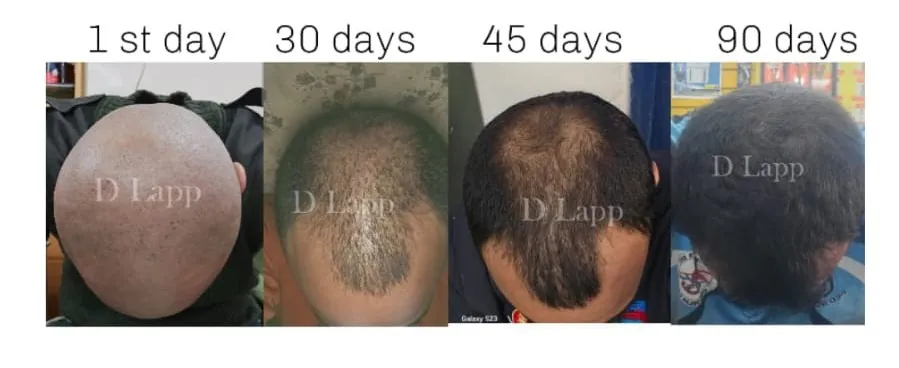
Mr. Dileep presented with near-total loss of terminal hair across the mid-scalp, vertex, and frontal regions. At age 38, the patient had a smooth, reflective scalp surface, typically indicating significant follicular dormancy. Traditional options would usually suggest extensive hair transplant surgery; however, the patient opted for the D Lapp Non-Transplantational Protocol.
2. Therapeutic Intervention
The treatment focused on cellular-level regeneration rather than surgical relocation of follicles. The protocol included:
Exosome Therapy: To provide essential signaling proteins that stimulate cellular communication and tissue repair.
Stem Cell Activation: Targeted bio-therapy to reactivate dormant hair follicles.
Transepidermal Drug Distribution (TEDD): Using specialized technology to ensure the scalp's deep layers receive growth-promoting compounds without the need for traditional injections.
Photobiomodulation (PBM): Application of specific light wavelengths to boost ATP production and increase blood flow to the follicular bulb.
3. Recovery Timeline
| Timeline |
Results & Clinical Progress
|
Day 1
| Baseline: Complete absence of visible hair on the crown; skin is smooth and shiny. |
Day 30
| Follicular Awakening: Early sprouting of vellus hairs. The "shiny" appearance of the scalp is reduced as fine hair breaks the surface. |
Day 45
| Intermediate Growth: Transition from vellus to terminal hair. Coverage begins to darken and bridge the gaps between the existing side hair. |
Day 90
| Full Restoration: Robust hair density achieved across the entire vertex and frontal zones. Significant improvement in hair texture and volume. |
4. Conclusion
Mr. Dileep’s case is a landmark example of how biological regeneration can address even the most severe grades of hair loss in a relatively short window of 90 days. The success of the treatment at the Calicut branch underscores the effectiveness of combining exosome technology with advanced drug delivery systems to achieve "surgery-like" results non-invasively.
Ready to take the first step toward healthy hair? Get in touch with D Lapp Hair Regenerative Clinic today.
